
GBP Suspension Patterns 2026: What We've Observed
- We often see service-area business suspensions alongside storefront cases
- Video verification failures often preceded formal suspension in early 2026 — a common warning signal in the cases we handled
- Hard policy suspensions are the largest single case type we see
- Failed appeals we reviewed usually did not have documentation we would describe as complete
- We often see HVAC, locksmith, plumbing, and roofing cases
- Complete documentation at intake is the preparation step we often see in appeals Google is able to review
- Re-filing an identical appeal without new evidence rarely succeeds in the cases we have observed
- Ownership disputes take longer than new listing suspensions. Google decides timing; we do not publish a median
Published: May 27, 2026 · Updated: September 28, 2026 · Author: Pushpender Sodlan, Founder & CEO, GBP Fixers
What this report covers
This is not a research paper. It’s a written account of what we’ve consistently seen while working GBP suspension and reinstatement cases over the past two years.
We handle GBP recovery cases spanning HVAC, locksmith, legal, healthcare, roofing, plumbing, real estate, and dozens of other categories. The patterns in this report come from that work: what types of businesses get suspended, what triggers we often see, and the documents we see requested. Google decides outcomes.
We are a Google Ads Partner (not GBP access). That status does not give escalation channels. What we do have is a wide range of cases — including the edge cases that reveal how Google’s enforcement actually works when things go wrong. We use the same official appeal paths as every business owner.
Everything here reflects what we’ve observed in case files. Where we’re generalizing, we say so. Where we’re drawing on a specific pattern we’ve seen repeatedly, we’re specific about that too.
How we compiled these observations
The observations in this report come from active GBP recovery cases handled by GBP Fixers from 2024 through June 2026. We publish the volume as hundreds of cases managed. We do not publish a precise case count or a country-share split.
Cases included in our pattern analysis cover all major suspension types: hard and soft policy suspensions, video verification failures, ownership disputes, new listing suspensions, and reinstatement denials. For a structured breakdown of each type and how they differ, see the GBP suspension classification framework. Cases span more than 30 business categories, and we often see trades and home services, legal, healthcare, and real estate.
A meaningful limitation of these observations is selection bias. Our caseload is not a random sample of GBP issues — it’s a sample of businesses that sought professional help, which skews toward more complex cases. Simple suspensions that business owners resolve themselves are not reflected. The patterns we describe should be understood as patterns among difficult or persistent cases, not as a representation of all GBP suspensions in the wild.
Each pattern in this report was reviewed by Pushpender Sodlan against the underlying case records before publication. We describe patterns as they appear in our caseload — with the frequency qualifiers we actually have evidence for, not the ones that would make the report sound more authoritative. For more on our review process, see the Intelligence Methodology page.
Key findings
These findings are drawn from our 2024–2026 caseload. Each reflects a pattern we’ve observed repeatedly — not a single outlier case.
- Service-area businesses come up often in our US suspension caseload.
- Video verification failures often preceded formal suspension in cases we handled in early 2026 — a common identifiable pre-suspension warning signal.
- Hard policy suspensions are the largest single case type we see by volume.
- Google decides reinstatement timing. Complete documentation is what lets a reviewer evaluate the file; prior denials add more rounds. We do not publish a median.
- Failed appeals we reviewed usually did not have documentation we would describe as complete — insufficient evidence, not a clear policy violation, is the usual failure mode we see.
- Re-filing an identical appeal without new evidence rarely succeeds in the cases we’ve observed.
- We often see HVAC, locksmith, plumbing, and roofing cases.
- Ownership disputes take longer to resolve than new listing suspensions. Google decides the timing; we do not publish a median.
- Businesses that produced complete documentation at intake gave reviewers something they could check; incomplete files were the usual reason an appeal could not proceed. We do not publish a success rate.
- Repeated mass enforcement waves affecting entire category groups appeared in our US intake in the year before this report.
Video: GBP Suspension Patterns 2026 — patterns we see
Watch the notes walkthrough behind these findings — suspension triggers, industry risk distribution, appeal patterns, and the timing factor.
What this video covers
- Why service-area businesses come up often in the cases we see — and what makes SAB appeals harder
- The suspension triggers we often see: NAP mismatches, keyword stuffing, residential address for an SAB
- Why video verification failures escalate into harder suspensions, and how preparation changes the evidence a reviewer can check
- What the appeal work actually shows: specificity wins, resubmitting the same appeal without changes does not give a reviewer anything new
- Google decides timing. We do not publish an approval-rate difference by how soon after suspension an appeal is filed.
Published June 17, 2026 · Watch on YouTube →
Who gets suspended
Service-area businesses
One pattern we see often: service-area businesses — contractors, tradespeople, mobile professionals — come up often in our suspension cases.
The reason isn’t complicated. Google’s automated systems may treat service-area categories as more likely to include fake listings. Google doesn’t publish how that check works. Fake contractor listings are genuinely common. We often see suspensions in legitimate service-area businesses. For the SAB triggers we see, see our SAB GBP Suspension Patterns 2026 report.
Categories we see suspended include HVAC, locksmiths, plumbing, roofing, water damage restoration, pest control, towing, and certain categories of legal services. This isn’t because these industries have worse compliance — it’s because these categories have a known fake-listing problem, and in our cases they get closer review.
Recent information changes as a suspension trigger
A recurring trigger we see across case types is recent listing changes — particularly changes to business name, address, category, or phone number made shortly before a suspension notice.
Google’s systems appear to treat substantive listing edits as re-verification events. For listings in sensitive categories, a category change or address update can move the listing into an active review state. If the review doesn’t resolve cleanly, suspension follows.
We’ve seen this happen with completely legitimate changes — a business that moved offices, a practice that added a service category, a contractor who updated their phone number. The change itself wasn’t a problem. The timing and category context made the listing a review target.
New listings in high-fraud categories
New GBP listings in certain service-area categories frequently encounter suspension before they ever generate meaningful traffic. This is particularly common for businesses in locksmith, HVAC, and water damage categories.
The pattern looks like this: a new listing is created, passes initial review, and then receives a suspension notice early in its life — often without the business owner understanding what triggered it. These cases are disorienting for business owners who did everything asked during setup. Google decides the timing.
Suspension type distribution
The list below is what we often see. It is not a measured share, and it should not be read as the mix of all GBP suspensions.
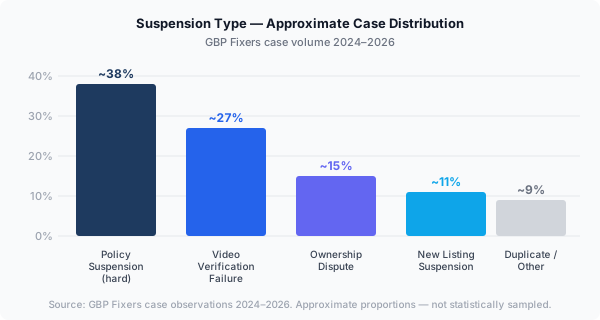
Qualitative order only. Hard policy suspensions and video verification failures both come up often. No percentages are published.
Industries we see in our cases
The table below is what we see in our cases. It is not a rate.
| Industry | What we see | Primary Trigger | Industry Guide |
|---|---|---|---|
| HVAC | Seen in our cases | SAB + category fraud association | HVAC suspension guide |
| Plumbing | Seen in our cases | SAB address + keyword stuffing | Plumbing suspension guide |
| Locksmith | Seen in our cases | Category we see often | Locksmith suspension guide |
| Roofing | Seen in our cases | New listing vulnerability | Roofing suspension guide |
| Pest Control | Seen in our cases | SAB + seasonal enforcement patterns | Pest control suspension guide |
| Auto Repair | Seen in our cases | Category change + address edit triggers | Auto repair suspension guide |
| Legal Services | Seen in our cases | Multiple listings + category misclassification | Legal suspension guide |
| Dental | Seen in our cases | Practitioner vs. practice listing conflict | Dental suspension guide |
| Electrical | Seen in our cases | SAB + category fraud overlap | Electrical suspension guide |
| Real Estate | Seen in our cases | SAB violations + agent vs. brokerage structure | Real estate suspension guide |
Pest control
Operators in pest control face a specific combination of SAB risk and seasonal enforcement timing. Because pest control is largely a service-area operation — technicians go to customer premises — these businesses operate under SAB rules that require hiding a physical address and limiting service area claims to a realistic coverage zone. What makes pest control distinct is that Google’s enforcement in this category appears to correlate with demand spikes. We see more pest control suspensions in spring and summer, when search volume peaks. Our interpretation is that increased traffic in these months also increases algorithmic scrutiny. A listing that coexisted with Google’s systems through winter can find itself flagged in April without any change to the listing itself. Pest control businesses should ensure SAB configuration is correct year-round — not just at initial setup — and should treat peak season as a period of elevated compliance vigilance.
Auto repair
Shops in auto repair enter our caseload most often through one of two patterns. The first is a category change that goes wrong — an existing listing that added or updated a service category, triggering a re-verification event that the listing didn’t survive. The second is sudden review activity that Google’s systems flag as anomalous. In auto repair, customer reviews are both a revenue driver and a suspension risk factor. Shops with strong Google Maps presence often accumulate reviews at a rate that can look suspicious to automated checks. Google doesn’t publish how those checks work, even when every review is legitimate. We’ve handled multiple auto repair cases where the suspension notice followed a period of unusually high review volume — organic review spikes that triggered the same signals Google uses to catch review manipulation. The defense is proactive compliance: accurate category setup, documented review solicitation practices, and consistent business information across all directories and citations.
Dental
Dental practices operate in a listing environment that Google treats differently from most health categories. The core issue is practitioner-versus-practice disambiguation: Google wants to list the dental practice as an entity, but also evaluates whether individual practitioners should have their own listings. This ambiguity creates a specific kind of suspension — the practice listing is flagged because it appears to duplicate a practitioner listing, or vice versa. We see this most often in practices that maintain individual dentist listings alongside a practice-level listing, a structure that triggers Google’s duplicate detection algorithms even when all listings are technically distinct entities. The fix isn’t always a reinstatement appeal; sometimes it requires restructuring the entire listing strategy before filing. Dental practices with multiple practitioners should review their GBP structure carefully before any new dentist joins the practice — not after the suspension has already occurred.
Electrical
Contractors doing electrical work are common in our SAB cases, largely because they operate in the same category space that attracts significant fraudulent listing activity. The suspension mechanism is familiar: legitimate electrical businesses get caught in algorithmic sweeps targeting the category for fraud rather than because of anything specific they’ve done. What makes electrical distinct in our caseload is that these businesses often have complex documentation situations — they may operate under both a registered company name and a trading name, they may have multiple vehicles with different branding, and they may work across multiple service areas under different compliance structures. This complexity creates inconsistencies between the GBP listing and the supporting documentation, which complicates appeal processes considerably. Electrical contractors should maintain meticulous records of their business registration, vehicle branding, and service area boundaries — precisely because the documentation bar for reinstatement in their category is higher than average across our caseload.
Video verification: what we’ve actually seen
Video verification is now the primary verification method for new and re-verification requests in most service-area categories. It’s also the step where many of our clients had already caused damage before they contacted us.
The mechanism is straightforward. Google asks the business to record a short video showing the business location and evidence of operation. The video is reviewed — sometimes automatically, sometimes by a human reviewer — and either accepted or rejected.
Where it goes wrong is usually one of three places.
Multiple failed attempts. Business owners who fail video verification once often try again at once, with the same setup. A second or third failed attempt triggers what we call Verification Friction — a compounding state that makes subsequent attempts harder to pass and, in some categories, leads directly to suspension. We advise clients who have already failed twice to stop attempting verification until we’ve reviewed their approach. Our video verification service covers pre-attempt coaching and, after repeated failures, a rebuilt verification plan on Google’s official path. For a breakdown of what goes wrong and how to approach a second attempt correctly, see our guide to GBP verification failures.
Environment issues. The video needs to show the business operating in a credible way. Home-based businesses in particular struggle here — the residential environment creates uncertainty for reviewers. This doesn’t mean home-based businesses can’t pass verification, but it means the video needs to be constructed more carefully to establish credibility.
Category-specific scrutiny. In early 2026, we noticed that businesses failing video verification in service-area categories — particularly HVAC, plumbing, and electrical — often encountered listing visibility issues in the weeks afterward, even when verification wasn’t formally connected to a suspension notice. The verification failure appeared to lower the listing’s trust signal score in a way that made subsequent algorithmic review more likely. This is an observation, not a confirmed mechanism — but we’ve seen it often enough that we treat video verification failure as a suspension risk signal, not just a verification setback. For a documented case of this pattern in the HVAC category, see our HVAC video verification case example. For a detailed account of the same cascade pattern in a Nashville residential SAB context — and exactly what documentation fixed it — see the Nashville HVAC contractor case example.
A field observation: what we keep seeing in 2026
One thing that’s come up repeatedly in our case intake over the first part of 2026 is a pattern we hadn’t seen at this volume before. Businesses that had been operating stable, compliant listings for one to three years started receiving suspension notices with no apparent trigger — no recent edits, no review spikes, no category changes.
When we dig into these cases, we often find that the listings had been in categories that Google quietly reclassified or added to elevated scrutiny lists. The business owner didn’t change anything. The category’s risk profile changed around them.
This is the kind of thing that doesn’t show up in Google’s documentation because it’s not policy — it’s enforcement calibration. But it’s real, and it’s showing up consistently enough in our intake that we’ve started asking about it specifically during assessments.
If your listing was suspended without an obvious trigger, this is one of the first things we look at.
What actually improves appeal outcomes
Across hundreds of cases managed, the pattern we keep seeing is documentation quality — the appeal narrative and the filing speed are not what we can point to. Google decides.
The owners who are best prepared are the ones who can produce clean documentation when the case starts. The documents we ask for are:
- Business registration documents matching the GBP listing details exactly
- Utility bills, lease agreements, or official correspondence showing the business address
- Photos of the physical location that are visually consistent with the GBP listing
- Evidence of active business operation — recent receipts, invoices, or service records
- Any prior correspondence with Google about the listing
When documentation is strong, even complex suspension types can move. When documentation is weak, appeals can stall. Google decides the timing.
The second most consistent pattern in failed appeals is repetition. Business owners who file the same appeal content multiple times, hoping that persistence will substitute for evidence, rarely succeed. Google’s review system doesn’t reward volume — it responds to new, credible information.
This is why we don’t file an appeal until we’ve assessed the documentation situation. Filing in a hurry with weak evidence often makes the case harder, not easier. If you’ve already had a reinstatement appeal rejected, our GBP reinstatement service specializes in cases with prior denials — the approach and documentation requirements are different from a first filing. Our appeal-rejected guide covers specifically what the rejection signals and what changes before a successful overturn. For a detailed pattern-level analysis of why appeals fail across suspension types — covering documentation gaps, verification-related rejections, and SAB-specific failure modes — see our appeal rejection patterns report.
What changes the path, by case type
Google decides timing. We do not publish a median or a promised range. These are the variables we see matter.
| Case Type | What changes the path |
|---|---|
| New listing suspension | Documentation completeness |
| Policy suspension (soft) | Category and evidence strength |
| Policy suspension (hard) | Whether the underlying issue is corrected before filing |
| Video verification failure | How many attempts have already failed |
| Ownership dispute | Whether the other party responds |
| Reinstatement denied | Whether the next filing adds new evidence |
Ownership disputes take longest in our experience because they often involve a former employee, agency, or previous business owner who holds access and may not respond to transfer requests. These cases require a specific evidence approach that takes time to build correctly.
What these observations don’t capture
There’s a category of case outcomes we track but can’t represent meaningfully in pattern data: the cases where Google doesn’t reinstate the listing but the business recovers its visibility through other means — a new listing under a different structure, a verified address change, or a verified relocation.
These outcomes aren’t failures. In some hard suspension cases, particularly those involving repeat policy violations or category fraud flags, a clean-start approach can be more reliable than indefinite reinstatement appeals. We’ve seen businesses stay stuck on a listing that had been flagged in ways that made reinstatement unlikely — and then move once they changed strategy. Google decides whether that works, and when.
We include this so the range of outcomes stays honest. Google decides which cases are reinstated.
Summary and conclusions
The patterns documented in this report share a common thread: most GBP suspensions that reach us have a specific, identifiable cause, which is where preparation starts. The businesses that struggle most are not the ones with the most severe policy violations. They’re the ones who filed the wrong appeal, filed without documentation, or filed too promptly and created a record that made subsequent attempts harder.
Service-area businesses in high-fraud categories face a structural disadvantage: they’re legitimate businesses operating in the same category space as fake ones, and Google’s enforcement systems don’t always tell the difference. That’s unlikely to change. The practical response is not to hope enforcement becomes more accurate — it’s to maintain documentation that makes the distinction clear the moment a suspension occurs.
Filing in a hurry with weak evidence is worse than preparing the evidence that matches the suspension reason and filing through the correct channel. Google decides timing. We do not publish an approval-rate difference by how soon an appeal is filed. Read our client results page for how businesses describe the work.
Using this intelligence
This report is not a checklist. The patterns we’ve documented here are general — your specific listing situation will have details that change which of these apply and how.
What this report is designed to do is give you a more accurate mental model of how GBP suspension and reinstatement actually works, so that the decisions you make are based on how the system behaves rather than how it’s supposed to behave.
If you’re not yet certain which type of suspension you’re dealing with, that’s the first thing to establish before any other action — different suspension types require completely different responses. Our GBP Suspension Diagnosis tool walks through the distinguishing characteristics of each type and points you toward the right recovery path based on your specific situation.
If you’re dealing with a suspension right now, the best use of this intelligence is as a frame for understanding your situation — not as a substitute for a direct assessment. Get a free audit and we’ll tell you which of these patterns applies to your case and what the most effective path forward looks like.
For the terminology we use throughout this report, see the GBP Suspension Terminology Framework. For a full synthesis of enforcement patterns, suspension patterns, video verification impacts, and reinstatement outcomes across 2025–2026, see the State of GBP Suspensions 2026 annual report — the flagship report that brings together findings from all GBP Fixers intelligence reports. For the six-stage recovery process applied to every case, see the GBP recovery methodology. For the compliance rules that govern what is permitted on a GBP listing, see the GBP compliance reference. For how Google’s review actions differ from a Business Profile suspension — and the correct official appeal route for each — see Google Review Enforcement and GBP Suspensions.
For the documents, corrections, and appeal-path choices we see requested, see What documentation shows up in GBP reinstatement cases. Google decides outcomes. For realistic timeline expectations by suspension type, number of prior denials, and whether a professional is handling the case, see the GBP Reinstatement Timeline Patterns 2026 report.
UK businesses: The patterns in this report are drawn primarily from our US caseload. We do not publish a country-share split. UK suspensions follow the same policy framework but differ significantly in the evidence package required for reinstatement — no contractor licences exist for most UK trades, and appeal packages are built instead around Companies House registration, professional body membership (Gas Safe, MLA, NICEIC), and council tax statements. For UK-specific patterns and documentation guidance, see the UK GBP Suspension Patterns 2026 report. For a documented UK case example, see the London locksmith suspension recovery case example.
Canadian businesses: Canadian cases are part of our caseload, concentrated in Ontario and British Columbia. We do not publish a country-share split. Enforcement patterns closely mirror the US, but documentation follows provincial licensing frameworks — Ontario Business Registry, Skilled Trades Ontario certification, and WSIB clearance for Ontario trades; BC Registry Services and Technical Safety BC for British Columbia. Quebec adds bilingual listing complexity. For Canada-specific suspension patterns and province-by-province documentation requirements, see the Canada GBP Suspension Hub. The Toronto HVAC case example is a single case history, not a guarantee.
Dealing with a GBP suspension? Get a free audit and we'll tell you what we see and what to fix first.